

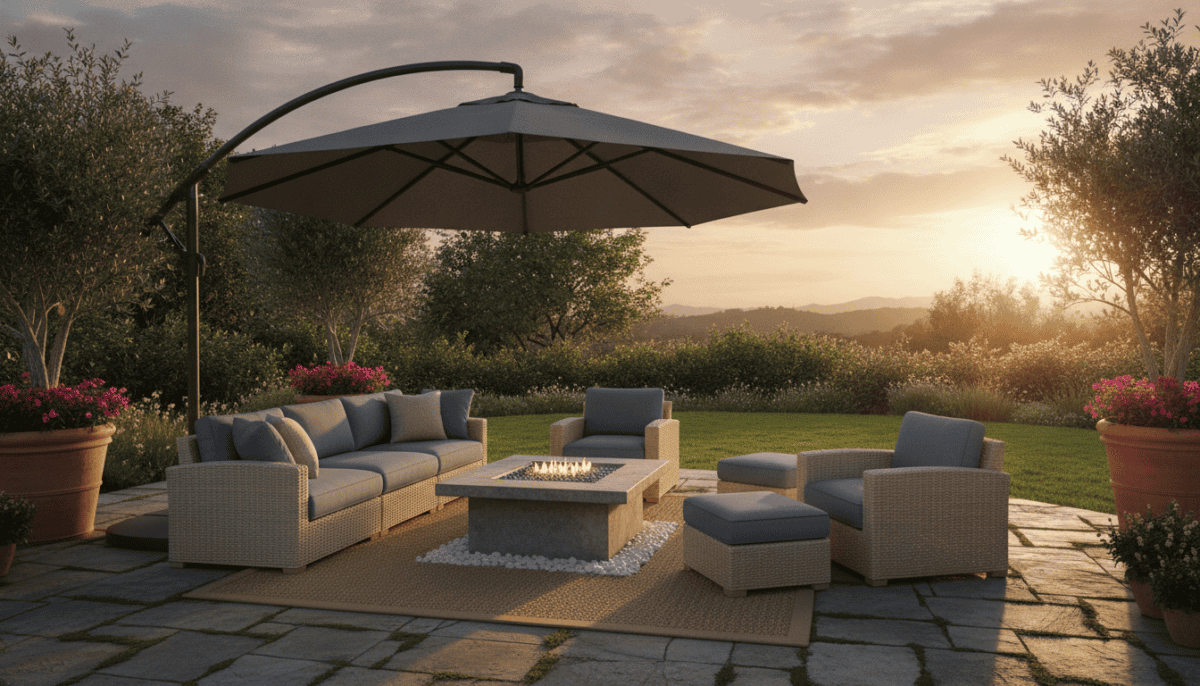
Shopping for shade and can’t decide between a pole umbrella and one of those offset “floating” designs? You’re not alone — it’s one of the most common questions we get from readers furnishing a new patio.
Quick Answer: A standard (market) umbrella is the better buy for a dining table or a small, budget-conscious patio — it’s cheaper, more wind-stable, and easier to store. A cantilever umbrella is the better buy for a lounge area, pool deck, or larger open patio, since its offset pole leaves the ground clear and lets you swivel shade to follow the sun. If your patio is under 150 sq. ft. or centers on a table, buy standard. If it’s a lounge/entertaining space over 150 sq. ft., buy cantilever.
Last Updated: August 2026 | Will Montgomery has spent years outfitting patios and backyards for Outdoor Space Accents, installing, weighting, and over-wintering both market and cantilever umbrellas through full outdoor seasons.
Cantilever vs. Standard Patio Umbrellas: The Core Difference
The name gives it away. A standard (market) umbrella has a center pole that drops through a table’s umbrella hole or into a freestanding weighted base — the same design you’ve seen at restaurants for decades. A cantilever umbrella mounts its pole off to the side, with the canopy suspended out over the seating area on a horizontal arm. That single design choice creates every other difference between them: cost, wind stability, footprint, and how much you can adjust the shade once it’s up.
We’ve set up both styles on our own patio while testing furniture and shade layouts for this site, and the honest answer is that neither one is “better” in the abstract — they’re built for different patios.
Side-by-Side Comparison
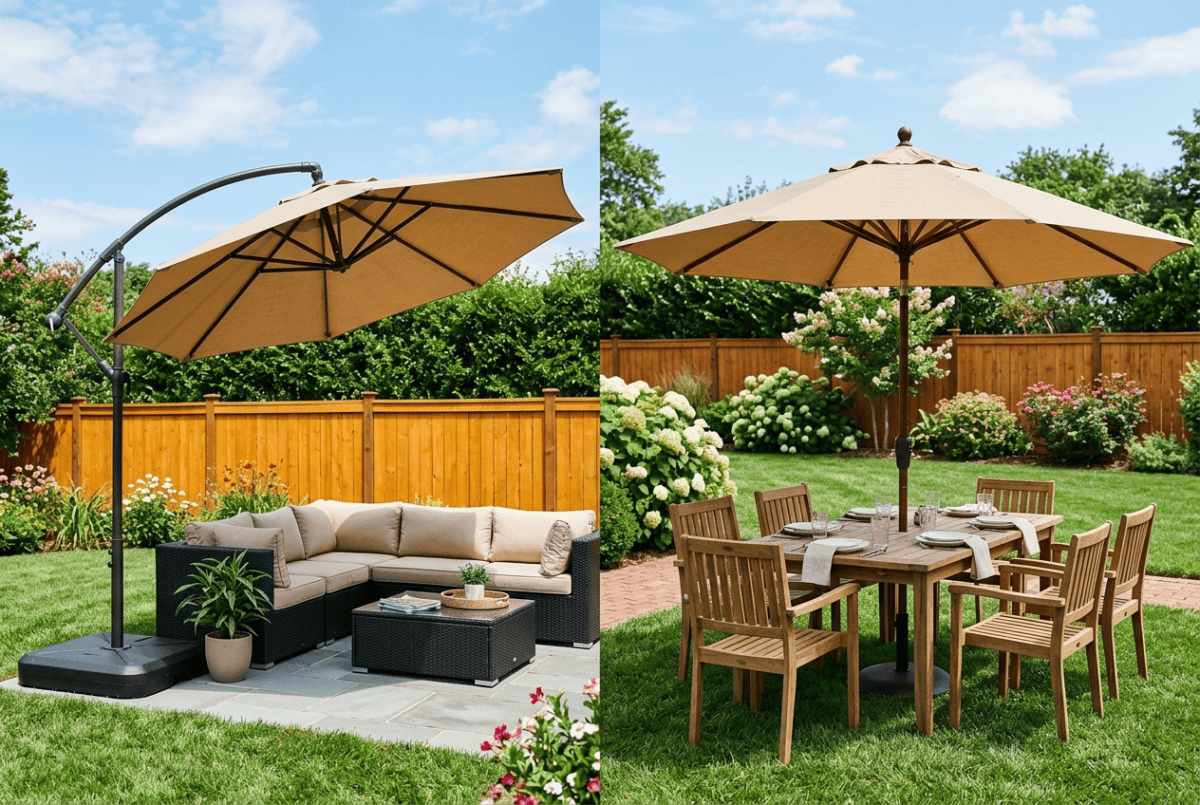
| Factor | Standard (Market) Umbrella | Cantilever Umbrella |
|---|---|---|
| Typical price | $40 – $250 | $200 – $700+ |
| Ground footprint | Small — pole sits under canopy | Large — base sits 4-6 ft to the side |
| Shade coverage | Blocked by center pole and table | Open, unobstructed seating area |
| Wind stability | More stable with a heavy base | More wind-sensitive; needs a heavier base |
| Adjustability | Tilts on one axis, limited rotation | Rotates 180°–360°, tilts multiple axes |
| Best over | Dining or bistro table | Lounge seating, daybeds, pool decks |
| Storage/moving | Lighter, easier to fold and move | Heavier, bulkier to store for winter |
Why You’d Choose a Standard Umbrella
A solid example is the Blissun 9-foot market umbrella — an inexpensive 8-rib workhorse with push-button tilt and a crank, sized right for a dining table.
- You’re shading a table. A center-pole umbrella drops right through the table’s built-in hole — no separate base to buy or store.
- Budget matters. A decent 7-9 ft market umbrella with a fade-resistant canopy runs well under $150, versus $300+ to start on a cantilever.
- Wind is a real concern. With a properly weighted base (we recommend 50+ lbs for a 9 ft umbrella), a market umbrella’s centered pole handles gusts more predictably than an offset arm.
- Space is tight. The footprint is just the pole itself — there’s no side base eating into a small patio or balcony.
Why You’d Choose a Cantilever Umbrella
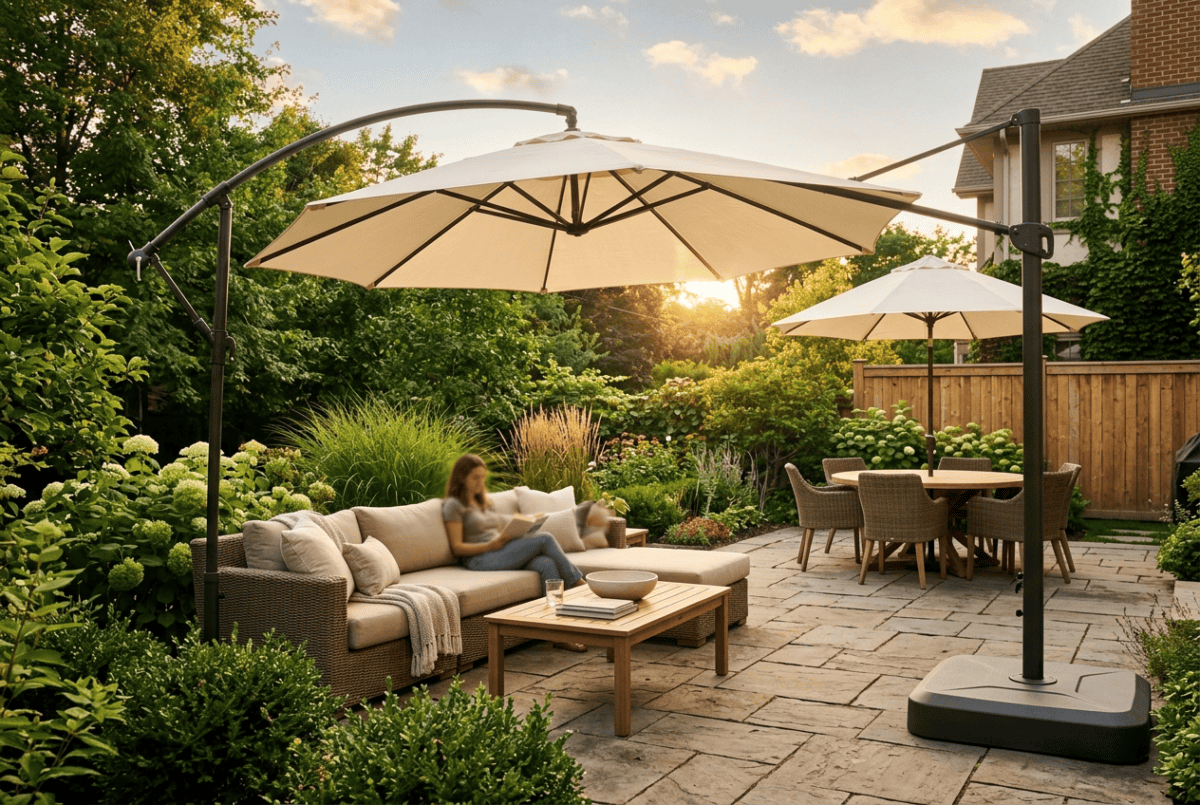
From experience: Once you weight a cantilever base correctly it isn’t really portable anymore, and even a heavy base won’t stop the canopy from dancing around in the wind. I learned quickly to crank it closed every time I walk away.
If you go cantilever, something like the OLILAWN 10-foot cantilever with the base included saves you sourcing a base separately — just remember it still needs real weight before it is safe in wind.
- You want open, unbroken shade. No pole in the middle of your lounge chairs, sectional, or daybed.
- You want to chase the sun. Most cantilever models rotate 180°–360° and tilt on two axes, so you can reposition shade through the afternoon without moving furniture.
- Your patio is a lounge, not a dining nook. Cantilevers are built to cover a seating cluster, not just a single table.
- You’re covering a larger footprint. A 10-13 ft cantilever canopy can shade a full conversation set that a market umbrella can’t reach.
What to Check Before You Buy Either One
- Base weight. Match the base to the umbrella size — as a rule of thumb, budget 40-50 lbs for a 7-9 ft market umbrella and 90-125 lbs (or a filled cantilever cross-base) for anything 10 ft or larger.
- Fabric. Solution-dyed acrylic (Sunbrella and similar) resists fading and holds up far longer than printed polyester — it costs more upfront but doesn’t need replacing every couple of seasons.
- Vented canopy. A vent at the top releases wind pressure instead of catching it like a sail — look for this on both styles.
- Tilt mechanism. Crank-and-tilt or push-button tilt matters more on a cantilever, where you’ll be adjusting angle throughout the day.
- Storage plan. If you’re in a climate with real winters, decide before you buy whether you have space to store a cantilever’s bulkier base and arm — this trips up more buyers than any spec on the box.
Bottom line: Buy standard if you’re shading a table on a budget or a smaller patio. Buy cantilever if you’re covering a lounge area and want unobstructed, adjustable shade — and budget extra for a heavier base either way. For deeper detail on base weight and wind ratings, see our wind resistance guide.
Frequently Asked Questions
Are cantilever umbrellas worth the extra cost?
Yes, if you’re covering a lounge or seating area rather than a single table — the unobstructed shade and ability to rotate toward the sun are worth the $150-400 price premium over a comparable market umbrella. If you’re only shading a dining table, a market umbrella does the same job for less.
Do cantilever umbrellas tip over easily?
Only if the base is undersized. Because the pole sits off-center, a cantilever puts more leverage on its base than a market umbrella does — budget for a base at or above the manufacturer’s minimum weight, and add water or sand-fillable plates in windy regions.
Can I put a cantilever umbrella on a small patio?
You can, but measure first. The offset base needs 3-4 ft of clear ground to the side of the seating area, which many small patios and balconies don’t have. A market umbrella is usually the more practical fit under about 150 sq. ft.
Which style holds up better in wind?
A market umbrella with a properly weighted base is generally more wind-stable because the pole is centered under the canopy. Cantilever umbrellas can handle wind well too, but only with a heavier, often water- or sand-filled base — an undersized cantilever base is the most common cause of tip-overs we see.
Do I need a separate base for a cantilever umbrella?
Yes — cantilever umbrellas don’t fit through a table hole, so the base is a required, separate purchase (sometimes bundled, often not). Factor that cost in before comparing sticker prices to a market umbrella.
Can a cantilever umbrella use a market umbrella’s base?
No. Cantilever umbrellas require a dedicated cross-base or plate base rated for their offset weight distribution — a standard umbrella base isn’t built to counter that leverage and isn’t a safe substitute.
Still narrowing down shapes and sizes? Our guides on square vs. round umbrellas and rectangular umbrella coverage can help you figure out exactly what fits your space before you shop. And if you’re weighing umbrellas against a fixed structure, our pergola vs. gazebo vs. canopy comparison covers the next step up.
Will is an electro-mechanical engineer and hands-on homeowner who has set up and tested both umbrella styles on his own patio while expanding his outdoor space with his wife Kim, who hosts backyard events.