


Quick answer: Yes — many freestanding and wall-mounted propane patio heaters can be converted to natural gas, but only with a manufacturer-approved conversion kit and, in most jurisdictions, a licensed gas fitter. Natural gas flows at a much lower pressure than propane, so the burner orifice has to be swapped for a larger one and a natural-gas regulator fitted. Plan on a permanent gas line, a slightly lower peak BTU output (natural gas carries about 10% less energy per cubic foot), and a warranty that may be voided if you do it yourself.
We get this question every fall from readers who are tired of hauling 20-pound propane tanks back to the hardware store. Converting a patio heater to natural gas means it ties straight into your home’s gas supply — no refills, no running out mid-party, and a lower per-hour running cost. But “can you” and “should you” are two different questions, and the honest answer depends on your specific heater. Here’s what we’ve learned taking heaters apart on our own patio.
A propane-to-natural-gas conversion replaces the heater’s gas orifice and pressure regulator so the burner can safely run on low-pressure natural gas piped from your home instead of high-pressure bottled propane.
Last Updated: August 2026 | Will Montgomery has spent years installing and testing outdoor patio heaters — including converting propane units to run off natural-gas lines — and knows where the real cost and safety tradeoffs show up.
The short answer: it depends on the heater
Some patio heaters are sold as “convertible” or “dual-fuel” and ship with (or offer) a natural-gas kit from the manufacturer. Those are the easy cases. Many mid-range and budget heaters, however, are sealed propane-only units where the manufacturer offers no kit and explicitly prohibits conversion. Trying to force a conversion on one of those is where people get into trouble. Before you buy any parts, find your model number and check the manual or the manufacturer’s site for an approved natural-gas conversion kit. If none exists, the conversion is not safe to attempt.
Why propane and natural gas aren’t interchangeable
The two fuels behave very differently, which is exactly why you can’t just screw a natural-gas line onto a propane heater. Propane is stored under high pressure and delivers more energy per cubic foot, so propane orifices are small. Natural gas arrives at your home at a fraction of that pressure and packs less energy per cubic foot, so it needs a larger orifice — roughly 2 to 2.5 times the hole size — plus a natural-gas regulator to hit the same BTU rating.
| Factor | Propane (LP) | Natural Gas (NG) |
|---|---|---|
| Supply pressure at appliance | ~11 in. water column (high) | ~7 in. water column (low) |
| Energy per cubic foot | ~2,500 BTU | ~1,030 BTU |
| Orifice size needed | Small | Larger (2–2.5x) |
| Fuel source | Portable tank | Fixed household line |
| Running cost | Higher per hour | Lower per hour |
| Portability | Move anywhere | Fixed location |
If the orifice is left too small for natural gas, the flame starves and the heater barely warms anything. Too large, and you get an oversized, sooty, potentially dangerous flame. That precision is the whole reason this is a job for a proper kit and a trained installer — not a drill bit and a hopeful afternoon.
What a conversion actually involves
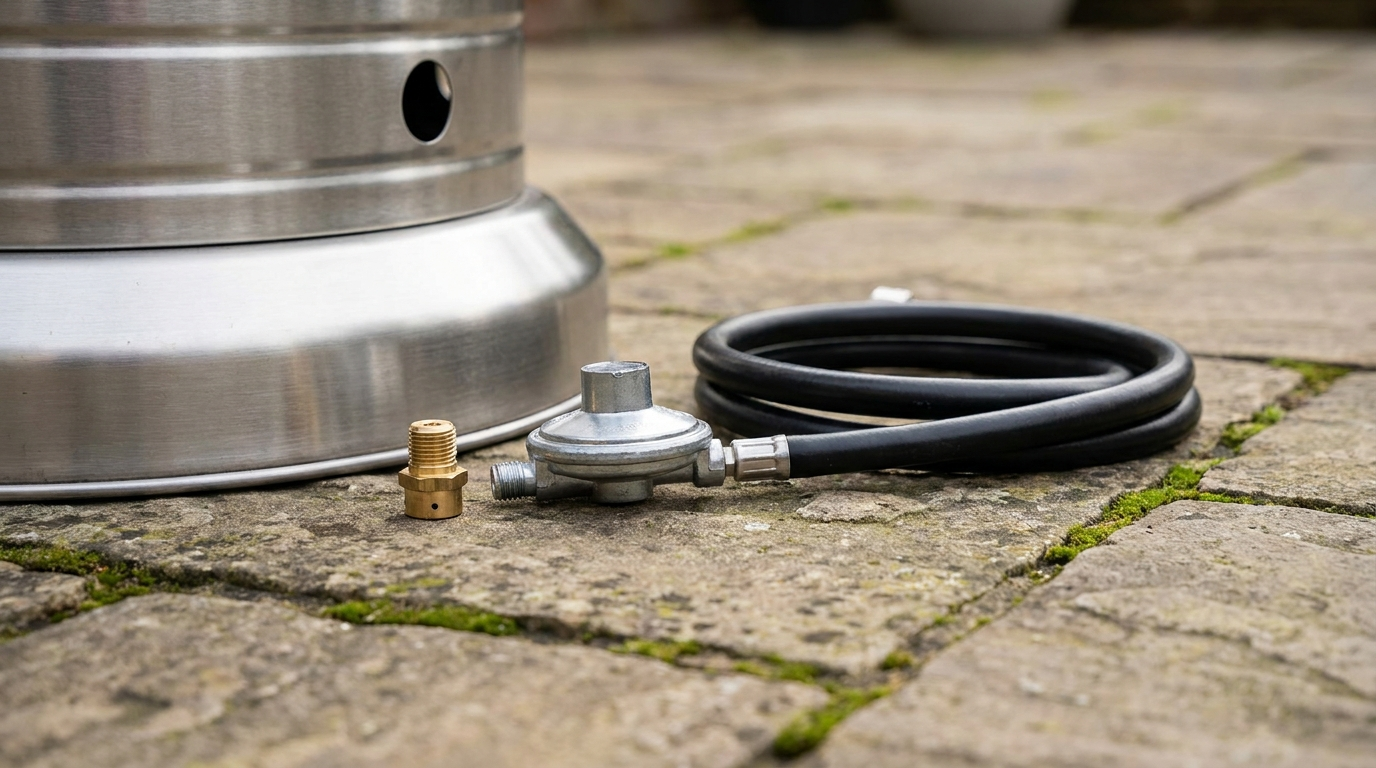
An approved natural-gas conversion kit for a patio heater typically includes the natural-gas orifice, a natural-gas regulator, a manifold or valve matched to your model, a flexible gas hose or quick-connect, mounting hardware, and (on freestanding units) an anti-tip safety chain. The general process looks like this:
- Confirm the heater has a manufacturer-approved NG kit for your exact model.
- Run a natural-gas supply line to the patio location (this is the big one — it usually means a plumber and a permit).
- Swap the propane orifice for the correctly sized natural-gas orifice.
- Replace the propane regulator with the natural-gas regulator and connect the supply line.
- Pressure-test every joint for leaks with soapy water — no bubbles allowed.
- Test-fire, check the flame is blue and stable, and confirm the tilt/tip-over cutoff still works.
Step 2 is what surprises most people. A freestanding heater becomes a fixed appliance once it’s plumbed to natural gas, so you lose the portability that made a propane heater convenient in the first place. If you like moving your heater around the deck, a conversion may not be the right call — it might be worth comparing your options in our electric vs. propane patio heater breakdown first.
When you should NOT convert
- No approved kit exists. If the manufacturer doesn’t sell an NG kit for your model, don’t improvise one.
- You want to keep it portable. Natural gas ties the heater to one fixed spot.
- The heater is old, rusted, or the tilt switch is flaky. Money spent converting a worn-out unit is money wasted.
- Your warranty still matters. A non-approved conversion almost always voids it.
- You’d be doing the gas work yourself. Most local codes require a licensed gas fitter for a permanent gas line.
What it costs
The kit itself is the cheap part. The gas line is where the budget goes. Here’s a realistic range based on typical pricing — your quotes will vary by region and by how far the gas line has to run.
| Item | Typical cost |
|---|---|
| Manufacturer NG conversion kit | $40–$150 |
| Gas line run + fittings (materials) | $100–$400 |
| Licensed gas fitter / plumber labor | $200–$600+ |
| Permit (where required) | $50–$150 |
| Typical all-in | $400–$1,000+ |
The payoff is on the running cost. Natural gas is usually much cheaper per hour than exchanging propane tanks, so a heater you run often can pay back the conversion over a couple of seasons. If you’re weighing operating costs across fuel types, our guide on the cost to run a patio heater puts real numbers to it.
DIY vs. hiring a pro
From experience: I haven’t converted a patio heater, but I’ve done furnaces and stoves and it’s straightforward — the whole trick is the orifice. Natural gas runs at lower pressure so it needs a bigger orifice; propane runs higher pressure with a smaller one. Don’t reverse them, don’t rig anything, and make sure you’ve got every part before you start.
Swapping the orifice and regulator on an approved kit is mechanically simple. Running and connecting a natural-gas line is not a DIY job in most places — it’s regulated work, and a bad joint on a gas line is a serious hazard. Our honest take: if you already have a capped natural-gas stub at the patio, an experienced DIYer can handle the kit swap and final hookup with a proper leak test. If there’s no gas line yet, hire a licensed fitter for the line and let them do the whole conversion so it’s inspected and on record.
Bottom line: Convert only if (1) your model has a manufacturer-approved NG kit, (2) you’re fine with the heater becoming a fixed fixture, and (3) a licensed fitter handles the gas line. Otherwise, you’re usually better off keeping propane or moving to a mounted electric infrared heater for a covered space.
Frequently asked questions
Can any propane patio heater be converted to natural gas?
No. Only heaters with a manufacturer-approved natural-gas conversion kit for that exact model should be converted. Many sealed propane-only units cannot be converted safely, and the manufacturer will say so in the manual.
Will a converted heater put out less heat?
Slightly. Natural gas carries about 10% less energy per cubic foot than propane, but a correctly sized natural-gas orifice keeps the BTU output close to the original. Poorly sized orifices are what cause big heat losses.
Do I need a permit to run a natural-gas line?
In most areas, yes. A permanent gas line typically requires a permit and a licensed gas fitter, plus an inspection. Check your local building department before starting.
How much does a natural-gas conversion cost?
The kit runs about $40–$150, but the gas line, labor, and permit push a typical all-in cost to roughly $400–$1,000 or more, depending on how far the line has to run.
Does converting void my warranty?
A non-approved conversion almost always voids the warranty. Using the manufacturer’s own kit and following its instructions is the only way to stay protected — and even then, confirm in writing.
Is natural gas safe for a covered patio?
Gas heaters produce combustion byproducts, so they need good overhead clearance and ventilation. For fully enclosed or low-ceiling spaces, electric infrared is usually safer — see our guide on patio heater clearance requirements.
Want the full picture on picking, sizing, and safely running a heater? Start with our pillar guide, Patio Heaters Explained, and the infrared vs. propane comparison.