

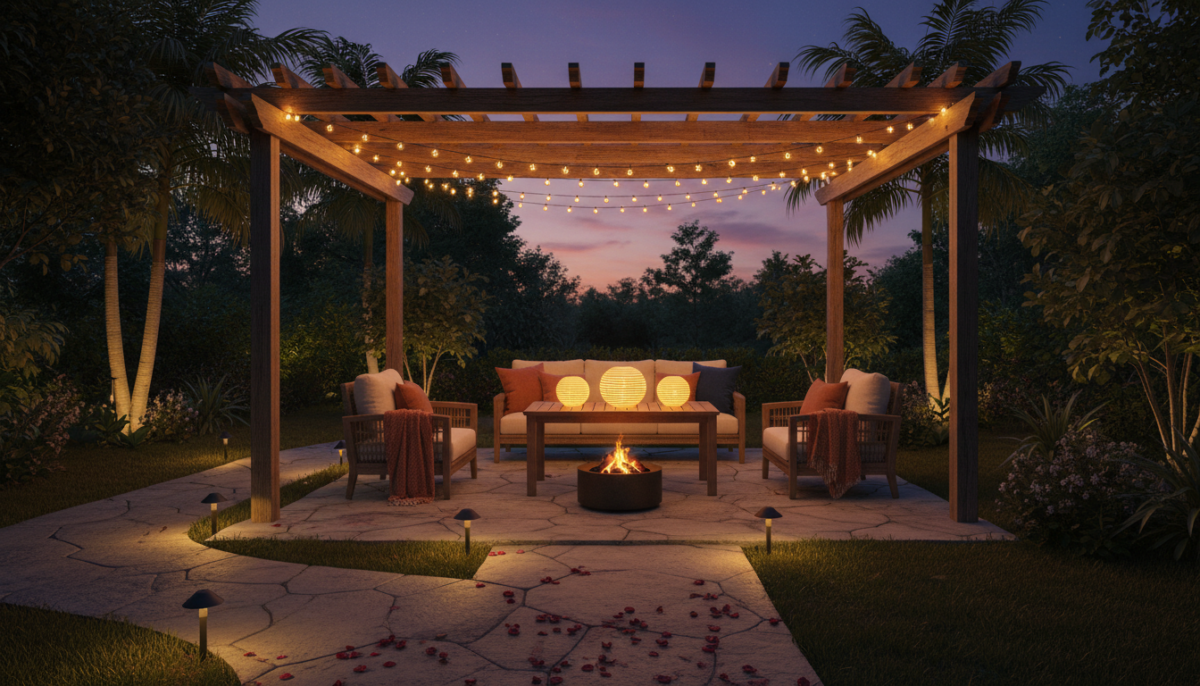
Quick Answer: Most backyard and patio fixtures need far less light than you think. Path and step lights work best at 100–200 lumens, wall and landscape accent lights at 50–300 lumens, string lights at 40–80 lumens per bulb, and spotlights or floodlights for security at 300–1,300 lumens. The goal on a patio isn’t maximum brightness — it’s layered light that lets you see safely without washing out the ambiance you’re trying to create.
If you’ve ever installed a set of “bright” solar path lights only to find them either blinding or barely visible after dark, you already know lumens matter more than watts or price. At Outdoor Space Accents we get this question constantly from readers planning a lighting layout from scratch, so here’s the fixture-by-fixture breakdown we actually use when speccing a backyard.
Last Updated: August 2026 | Will Montgomery has spent years designing and testing backyard lighting setups, from solar path lights to low-voltage landscape systems.
Lumens by Fixture Type: The Full Breakdown
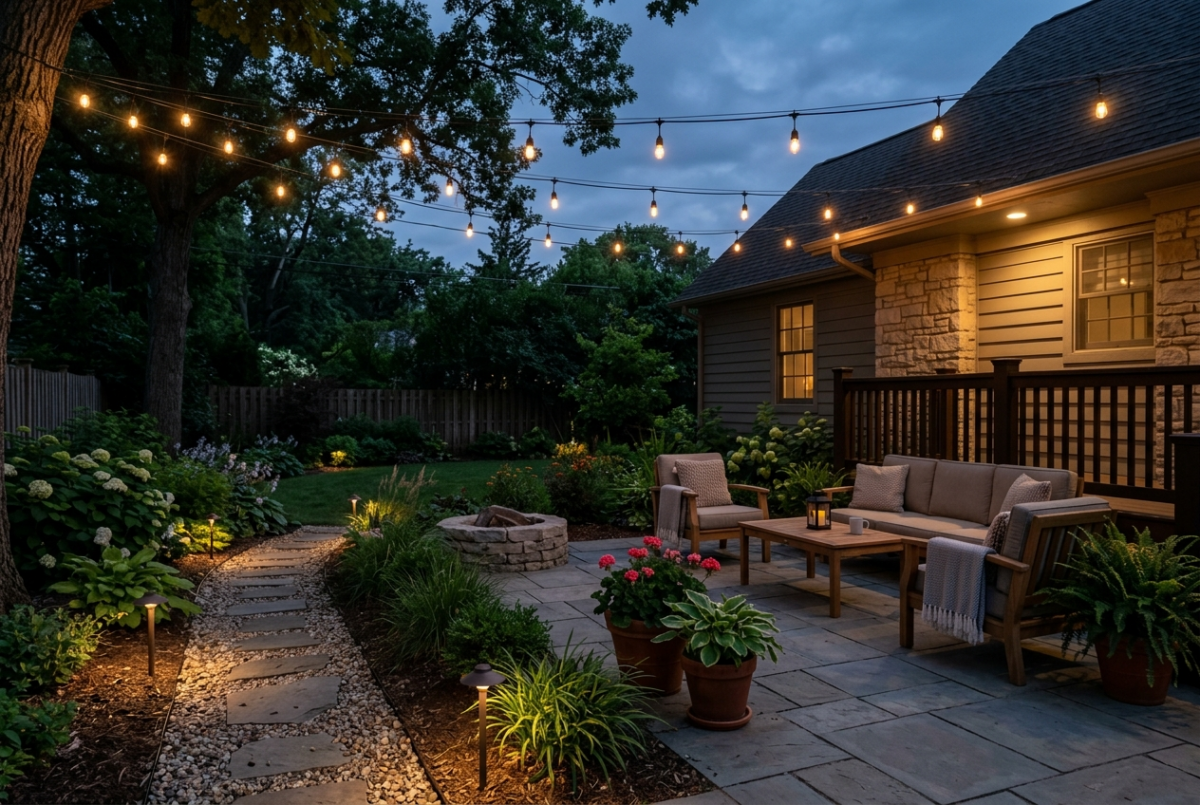
A lumen measures total visible light output — it’s a better measure than watts because LED and solar fixtures produce wildly different brightness per watt. Here’s what to look for by fixture type.
| Fixture Type | Recommended Lumens | Why |
|---|---|---|
| Path & step lights | 100–200 | Enough to mark the edge without blinding anyone walking past |
| String lights (per bulb) | 40–80 | Ambiance over function — dimmer bulbs read as “cozy,” not “stadium” |
| Wall & hardscape accents | 50–185 | Meant to highlight texture, not illuminate the whole yard |
| General landscape/uplights | 50–300 | Wide range depending on tree size and how far the light throws |
| Post & pendant lights | 120–180 | Functional ambient light for a seating or dining area |
| Deck & stair lights | 12–100 | Low output is safer — too bright creates glare looking down steps |
| Spotlights (trees, facades) | 300–700 | Needs enough throw to reach a canopy or wall from a distance |
| Security/motion floodlights | 700–1,300 | Built to flood a large area instantly, not for ambiance |
How Many Lumens Do You Need for a Patio Specifically?
From experience: On my own patio I keep everything around 200 lumens in warm white — the lighting is decoration more than anything. The one thing I can’t stand outdoors is daylight-Kelvin bulbs; unless you genuinely need to see for a task, that cold color kills the whole mood.
For a patio, aim for 100–300 lumens per fixture, layered across 3–5 fixtures rather than one bright source. Most patio lighting — string lights, post lights, lanterns, wall sconces — is decorative first and functional second. A patio doesn’t need runway-level brightness; it needs even, layered light so no single dark corner or glare spot ruins the space.
A simple way to think about it: if you can read a menu or see your food clearly at the table, and you can’t see the bulb’s filament glare from your seat, you’ve got the balance right. Overhead string lights around 40–60 lumens per bulb spaced every 12–18 inches will out-perform a single 300-lumen fixture for comfort, because it spreads the light instead of creating one hot spot.
How Many Lumens for a Whole Backyard?
There’s no single number for “a backyard” because you’re lighting several zones at once — a path, a patio, maybe a fire pit area, and the perimeter. Instead of one lumen count, budget by zone:
- Walkways and paths: 100–200 lumens per fixture, spaced 6–8 feet apart
- Seating/dining patio: 100–300 lumens per fixture, 3–5 fixtures layered
- Fire pit or lounge area: 50–150 lumens — you want firelight to stay the focal point
- Tree or facade uplighting: 300–700 lumens per spotlight, depending on canopy height
- Driveway or perimeter security: 700–1,300 lumens on motion sensors only
Add those zones up and a typical suburban backyard lighting plan runs somewhere between 1,500 and 4,000 total lumens across every fixture combined — not on one switch. That total is spread thin on purpose. For the full layout strategy, see our complete backyard lighting guide.
How to Choose the Right Lumens: A 4-Step Method
- Identify the job first. Safety (steps, paths) needs less light than you’d guess. Ambiance (dining, lounging) needs even less. Security needs the most.
- Check the color temperature too. A 100-lumen bulb at 2700K (warm white) reads as cozier and brighter-feeling than a 100-lumen bulb at 5000K (daylight), which looks clinical outdoors.
- Count your fixtures, not just your total. Ten 50-lumen path lights spaced evenly beat two 250-lumen lights with big dark gaps between them.
- Test before you commit to a full run. Buy one or two fixtures, place them at night, and walk the space before ordering the rest of the set — solar especially can under-deliver on the lumens printed on the box.
Solar vs. Wired: Does the Power Source Change the Lumens You Need?
No — the target lumen range for a path light or spotlight doesn’t change based on power source, but solar fixtures often ship rated higher than they actually perform once the battery ages or the panel sits in partial shade. When comparing a solar path light rated at 150 lumens to a wired one rated at 150 lumens, expect the solar version to run dimmer in year two. Budget roughly 20–30% higher rated lumens if you’re going solar to land in the same real-world brightness range.
Frequently Asked Questions
How many lumens is too bright for a patio?
Above 500 lumens per fixture on a patio usually feels harsh unless it’s a large open space. If you notice glare, hot spots, or bugs swarming a single fixture, you’ve overshot — drop to 100–300 lumens per fixture and add more fixtures instead.
How many lumens do solar path lights actually put out?
Most budget solar path lights are rated 20–100 lumens, though the box may claim higher. Premium solar path lights with larger panels and batteries can hit 150–200 lumens reliably. See our landscape lighting kit picks for models that hold their rated output.
What’s the difference between lumens and watts for outdoor lights?
Watts measure energy used; lumens measure light produced. A 9-watt LED bulb can produce as much light as a 60-watt incandescent bulb, so always shop by lumens, not watts, when comparing outdoor fixtures.
How many lumens do I need for string lights over a patio?
Aim for 40–80 lumens per bulb on a standard string light run. Spaced every 12–18 inches across the patio, that gives you soft, even ambient light without any single bulb reading as glaring.
Do I need more lumens for a bigger backyard?
You need more fixtures, not necessarily brighter ones. Adding fixtures at the same lumen range keeps light even across a larger area; cranking up lumens per fixture just creates hot spots and dark gaps between them.
Key Takeaways
- Patio fixtures: 100–300 lumens each, layered across multiple fixtures
- Path/step lights: 100–200 lumens; string lights: 40–80 lumens per bulb
- Security/floodlights are the outlier at 700–1,300 lumens — keep those on motion sensors, away from seating areas
- Shop by lumens, not watts, and budget solar fixtures 20–30% higher to offset real-world dimming
Ready to plan the full layout instead of fixture-by-fixture? Start with our backyard lighting guide, then check out how to hang string lights without trees and our backyard lighting ideas for layout inspiration.