

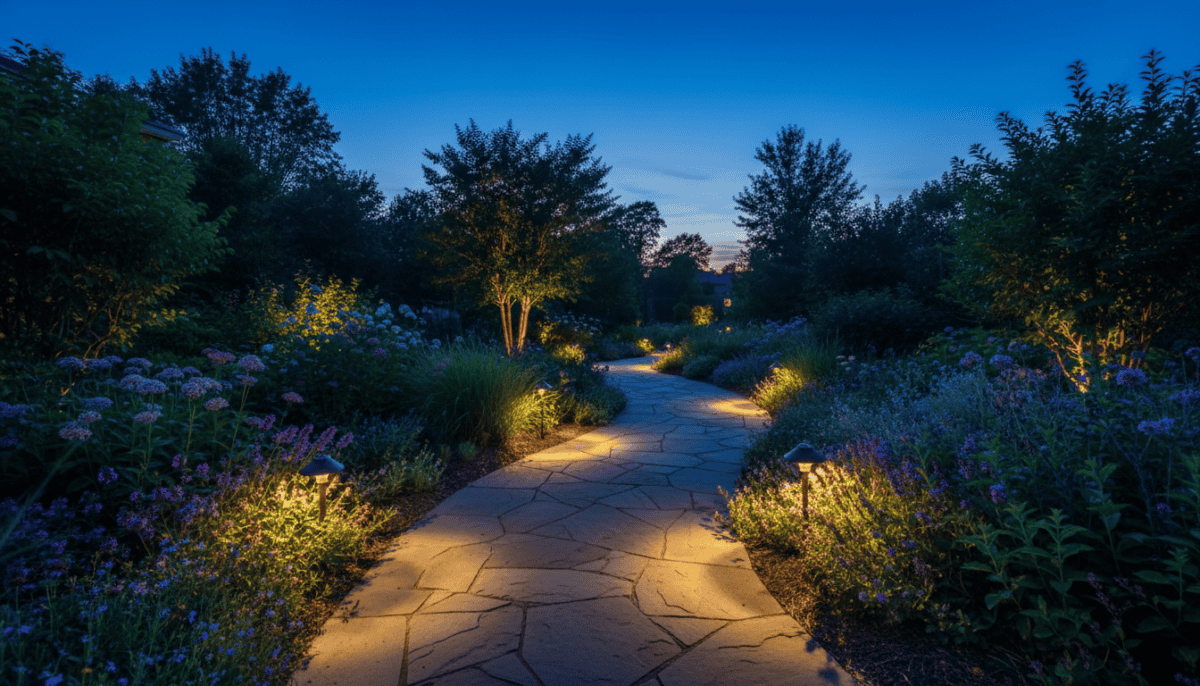
Quick answer: The best low-voltage landscape lighting kit for most yards is a 12-piece LED system paired with a 300-watt transformer, because it lights a full front yard, leaves room to add fixtures later, and runs on safe 12-volt power you can install yourself in an afternoon. Our top overall pick is the SUNVIE 12-Pack with a 300W transformer; if you want the cheapest reliable path-light setup, the Moonrays 6-pack kit is hard to beat.
At Outdoor Space Accents we spend most of our time helping homeowners and renters light patios, paths, and backyards without hiring an electrician. Low-voltage kits are the sweet spot: bright enough to matter, safe enough to bury with a garden trowel, and cheap enough to expand one section at a time. Below are the five kits we’d actually put in our own yards in 2026, plus a plain-English guide to picking the right transformer size so you don’t buy twice.
A low-voltage landscape lighting kit is a 12-volt outdoor lighting system — transformer, cable, and fixtures — that safely lights paths, garden beds, and features without any line-voltage wiring.
Last Updated: July 2026 | Will Montgomery has spent years installing and troubleshooting low-voltage landscape lighting in his own yard.
Our Top Pick at a Glance
🏆 Top Pick — SUNVIE 12-Pack Low-Voltage Landscape Lights with 300W Transformer. Twelve cast-aluminum fixtures, a big 300-watt transformer with a built-in timer and photocell, and tool-free wire connectors. It has the headroom to light a whole front yard and the build quality to survive real winters, which is why it’s our default recommendation for a first serious system. Check current price on Amazon.
Best Low-Voltage Landscape Lighting Kits Compared
| Kit | Best For | Fixtures | Transformer | Material |
|---|---|---|---|---|
| SUNVIE 12-Pack + 300W | Best overall | 12 spot/path | 300W, timer + photocell | Cast aluminum |
| Moonrays 6-Pack Pathway Kit | Best budget | 6 path | 24W included | Metal/plastic |
| Malibu 120W Starter Kit | Best for beginners | 8 spot + path | 120W | Metal |
| SUNVIE RGBW 12-Pack + 300W | Best color / smart | 12 spot | 300W | Aluminum |
| SUNVIE 12W Spotlights (8-Pack) | Best for uplighting | 8 spot | Sold separately | Aluminum |
How to Choose the Right Low-Voltage Kit
From experience: most people just buy a pre-sized kit from Home Depot or Lowe’s, matched to exactly what’s in the box with maybe a little headroom on the transformer. The trap is adding fixtures later — go past the transformer’s capacity and it pulls more amps than it can supply. Long runs cause voltage drop that pulls even more amps, so on a long run put the transformer in the middle and feed both directions.
The right kit comes down to four numbers: transformer wattage, fixture count, cable length, and fixture material. Get those right and installation is genuinely a one-afternoon job.
Transformer wattage (the number people get wrong)
Add up the wattage of every fixture, then pick a transformer rated at least 20% higher so you have room to grow. A dozen 4-to-8-watt LED fixtures draw well under 100 watts, so a 300-watt transformer like the one in our top pick leaves you plenty of headroom to add uplights next season. Buying a transformer with no spare capacity is the most common reason people end up shopping twice. The same math applies if you’re running post cap, stair riser, or recessed deck lights off one transformer — see our deck lighting guide for fixture-by-fixture cost and wattage.
Fixture count and cable length
Most front-yard walkways need six to twelve fixtures. Keep total cable runs under about 150 feet on the included wire, and if you’re pushing a long run, split it into two lines from the transformer to avoid the far lights looking dim (voltage drop). Kits like the SUNVIE 12-pack ship with 100+ feet of wire and tool-free connectors, which is what makes them beginner-friendly.
Fixture type and material
Path lights wash a walkway; spotlights (uplights) throw a beam up a tree trunk or house facade. A good starter system mixes both. On material, cast aluminum and brass outlast plastic by years outdoors — every kit on our list except the budget Moonrays uses metal fixtures, and that’s the single biggest predictor of whether a system still looks good in year three.
If you want the full walkthrough on layout and safety before you dig, our complete backyard lighting guide covers where to place each fixture, and whether low-voltage lighting is safe from shock answers the question most first-timers ask.
The 5 Best Low-Voltage Landscape Lighting Kits for 2026
1. SUNVIE 12-Pack + 300W Transformer — Best Overall
This is the kit we recommend to most homeowners. You get twelve cast-aluminum fixtures and a 300-watt transformer with a built-in timer and dusk-to-dawn photocell, so the lights come on by themselves. The tool-free wire connectors are the real story — no stripping wire, no wire nuts — which is what turns this from a weekend project into an afternoon one. The generous transformer means you can start with a walkway and add tree uplights later without upgrading anything.
Pros: big transformer with timer + photocell; metal fixtures; easy connectors; room to expand. Cons: twelve fixtures is more than a tiny yard needs; warm-white only. Check price on Amazon.
2. Moonrays 6-Pack Pathway Kit — Best Budget
When someone just wants to line a front walk cheaply and be done, this is the kit we point them to. Six LED path fixtures and a small 24-watt transformer come in the box, so there’s nothing else to buy for a basic path. It’s the most plastic-heavy option here and the transformer has no headroom to grow, but for lighting one walkway on a tight budget it does exactly what it promises.
Pros: lowest cost; everything included; genuinely plug-and-go. Cons: small transformer, no room to expand; less weatherproof than metal kits. Check price on Amazon.
3. Malibu 120W Starter Kit — Best for Beginners
Malibu has been the hardware-store default for low-voltage lighting for decades, and this kit is a sensible first system: a 120-watt transformer plus a mix of spot and pathway lights so you can try both looks. It sits between the budget Moonrays and the full SUNVIE system — enough capacity for a modest front yard, with the brand familiarity that makes replacement parts easy to find locally.
Pros: trusted brand; mixed spot + path fixtures; parts easy to source. Cons: 120W caps how far you can expand; halogen versions run hotter and dimmer than newer LED kits. Check price on Amazon.
4. SUNVIE RGBW 12-Pack + 300W — Best for Color and Smart Control
If you want white light most nights and color for holidays or game days, this is the kit. The RGBW fixtures do warm white plus full color, and the 300-watt transformer runs the whole set. It’s the pick for anyone who was tempted by permanent holiday lighting but wants landscape fixtures they’ll use year-round instead of a one-trick string.
Pros: white + full color in one fixture; big transformer; festive without being tacky. Cons: more setup than plain white; color modes are a nice-to-have you may rarely use. Check price on Amazon.
5. SUNVIE 12W Spotlights (8-Pack) — Best for Uplighting
These aren’t a full kit — there’s no transformer in the box — but they’re the fixtures we’d add to any system when it’s time to light trees, columns, or a house facade. At 12 watts each they’re bright enough to graze a two-story wall, and they run on the same 12-volt line as the kits above, so they drop straight into an existing SUNVIE or Malibu setup. Pair them with the 300W transformer from our top pick.
Pros: genuinely bright uplighting; integrates with any 12V system; aluminum housings. Cons: no transformer or wire included; overkill for low path lighting. Check price on Amazon.
How to Install a Low-Voltage Kit (the Short Version)
Lay every fixture where you want it before connecting anything. Run the cable from the transformer along the fixture line, clip each light onto the cable with its connector, then mount the transformer on an outdoor outlet at least a foot off the ground and set the timer. Bury the cable a few inches deep once you’re happy with the look. No permits, no line voltage, no electrician — that’s the whole appeal of going low-voltage instead of hardwired.
Frequently Asked Questions
What size transformer do I need for landscape lighting?
Add up the wattage of all your fixtures and choose a transformer rated at least 20% higher. For a typical 8-12 LED-fixture yard, a 120W transformer is the minimum and a 300W gives you room to expand. Undersizing the transformer is the most common low-voltage mistake.
Are low-voltage landscape lights safe to install myself?
Yes. Low-voltage systems run on 12 volts stepped down by the transformer, so the cable and fixtures are safe to handle and bury without an electrician or a permit. Only the transformer plugs into standard household power, and it’s designed for outdoor outlets.
How many landscape lights can one transformer run?
As many as fit within its wattage rating, minus a safety margin. A 300-watt transformer can run roughly 30-50 typical LED fixtures, while a small 24-watt kit transformer is maxed out by the fixtures it ships with. LED fixtures draw far less than old halogen ones, so you can run many more per transformer.
Are LED landscape lights better than halogen?
For almost everyone, yes. LED fixtures use a fraction of the wattage, run cool, and last years longer, which means more fixtures per transformer and lower running cost. Older Malibu-style halogen kits still work but are being phased out in favor of LED.
How far apart should path lights be spaced?
Six to eight feet apart is the usual range for path lights — close enough to create a continuous glow, far enough to avoid a runway look. Uplights for trees are placed individually at the base of each feature rather than evenly spaced.
Can I add more lights to a kit later?
Yes, as long as your transformer has spare wattage and your cable run isn’t already maxed out. This is exactly why we recommend buying a larger transformer than you need on day one — a 300W unit lets you start with a path and add tree uplights next season with no new hardware.
The Bottom Line
For most yards, buy the SUNVIE 12-Pack with the 300-watt transformer, install a walkway first, and leave yourself room to add uplights later. If budget is the priority, the Moonrays 6-pack lights a path for the least money, and the Malibu kit is the friendliest on-ramp if you like buying a known brand. Whichever you choose, going low-voltage keeps the whole project a safe, permit-free afternoon.
Once your fixtures are in, browse our other lighting guides at Outdoor Space Accents — from the best solar lights for a backyard to hanging string lights with no trees — to finish the look.
Reviewed by Will, an electro-mechanical engineer and DIY homeowner who wires and installs low-voltage lighting around his own patio and backyard.