

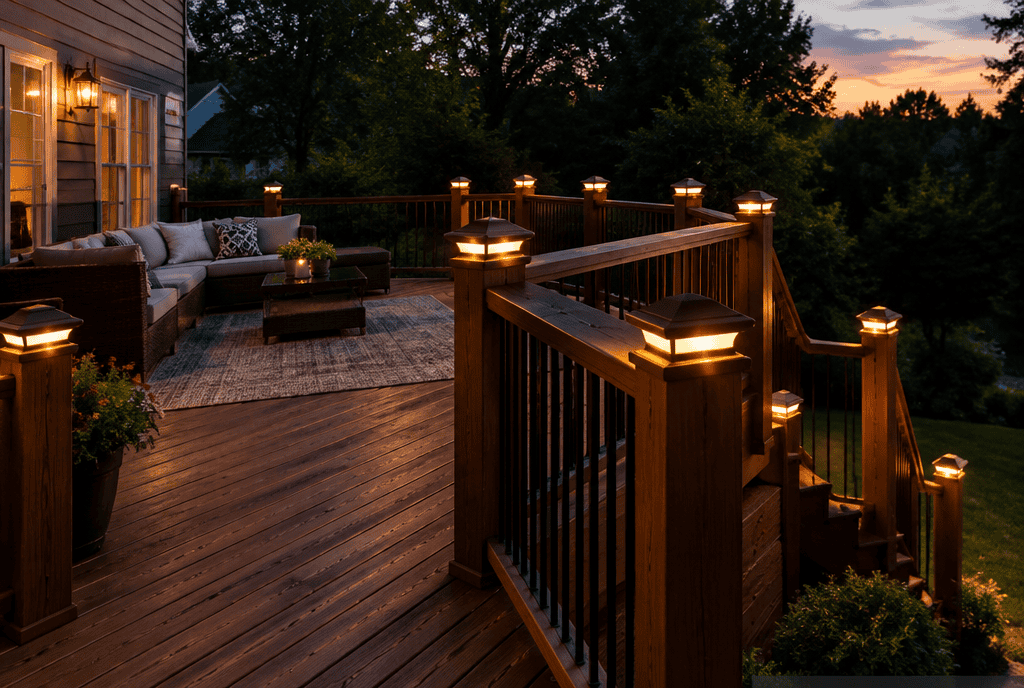
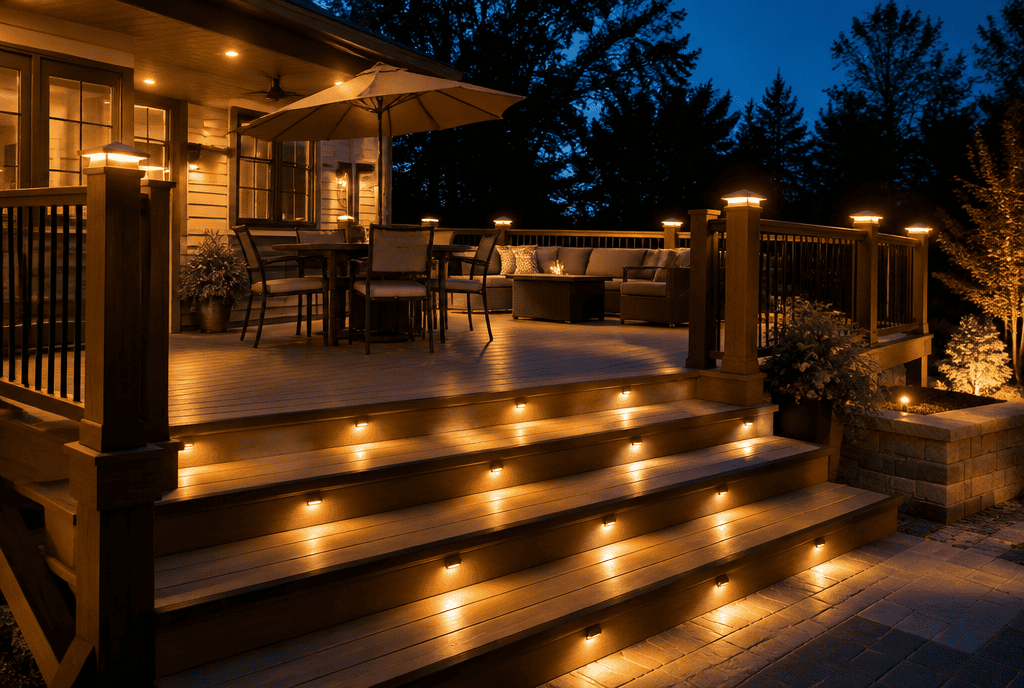
Quick Answer: Post cap lights are the easiest upgrade — they sit on top of railing posts with no wiring and mark the deck’s perimeter. Stair riser lights are the safety-focused option, lighting each step so no one misses one in the dark. Recessed lights sit flush with the deck or stair surface for the cleanest, most minimalist look, but need more cutting and wiring work to install. Most decks benefit from layering at least two of the three.
If you’ve stood on your deck after sunset and realized you can’t see the stairs, you already know why deck lighting matters more than it looks like it should. There are three main ways to light a deck — post cap, stair riser, and recessed — and they solve different problems. Here’s how each one works, what it actually costs, and which combination makes sense for your deck.
Post Cap Lights: The Easiest Upgrade
Post cap lights replace the plain cap on top of your railing posts with a low-voltage LED version that glows softly from above. They’re the most popular deck lighting upgrade for a reason: most solar or low-voltage versions install in under an hour with no electrical knowledge required, and they instantly mark the deck’s perimeter at night.
- Best for: Ambient lighting and defining the edge of a deck or railing line.
- Installation: Solar versions just sit on the post — no wiring. Low-voltage versions need a small hole drilled for wire but still no electrician.
- Limitation: Doesn’t help much with stair visibility if your stairs don’t have railing posts at every step.
An example: the VOLISUN 6-Pack Solar Post Cap Lights (2 color modes, fits 4×4 and 6×6 posts, about $36) needs no wiring at all — it just sits on the post.
From experience: If you have the choice, go solar for post caps — it’s one less wire to run and they’re just as easy to swap later. I’ve skipped them on my own vinyl fence rail since I didn’t want the look, but on a wood or composite deck railing they’re an easy, no-wiring win.
Stair Riser Lights: The Safety Option
Stair riser lights mount into the vertical riser of each step and aim the light down and across the tread below — not out into your eyes. This is the lighting type that actually prevents missed steps, which is why it’s worth prioritizing over post caps if your deck has more than two or three stairs, especially if anyone in the house has mobility or vision concerns.
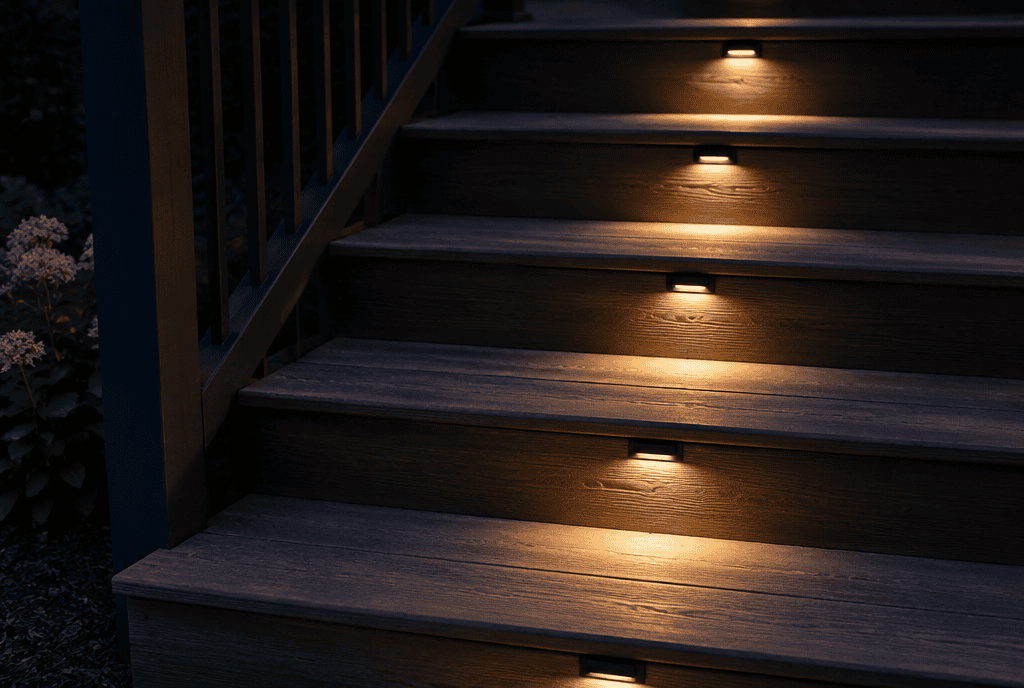
- Best for: Stair safety — this is the lighting type building codes and insurers actually care about.
- Installation: Requires cutting a small recess into each riser board and running low-voltage wire; a moderate weekend DIY project or a few hours for an electrician.
- Cost: Fixtures run $10-$70 each; professionally installed, expect $175-$600 per fixture including labor, or roughly $75-$150/hour if you’re paying an electrician by the hour for a multi-step run.
A kit like the QACA LED Deck Stair Lighting Kit (10 lights, low-voltage, IP65 waterproof, warm white, about $65) covers a typical 8-10 step run.
From experience: Back when we had a deck, stair lighting like this wasn’t nearly as available or easy to install as it is now. The real challenge with stair risers usually isn’t the fixture — it’s hiding the wire cleanly, since these almost always run on low-voltage wire rather than solar.
Recessed Deck Lights: The Clean, Minimalist Look
Recessed lights sit flush with the surface of your decking boards or stair treads, so during the day they’re barely visible — no fixture sticking up, no visible wire. At night they cast a diffuse glow across the deck surface or along a pathway. This is the fixture type most often used in modern, high-end deck designs.
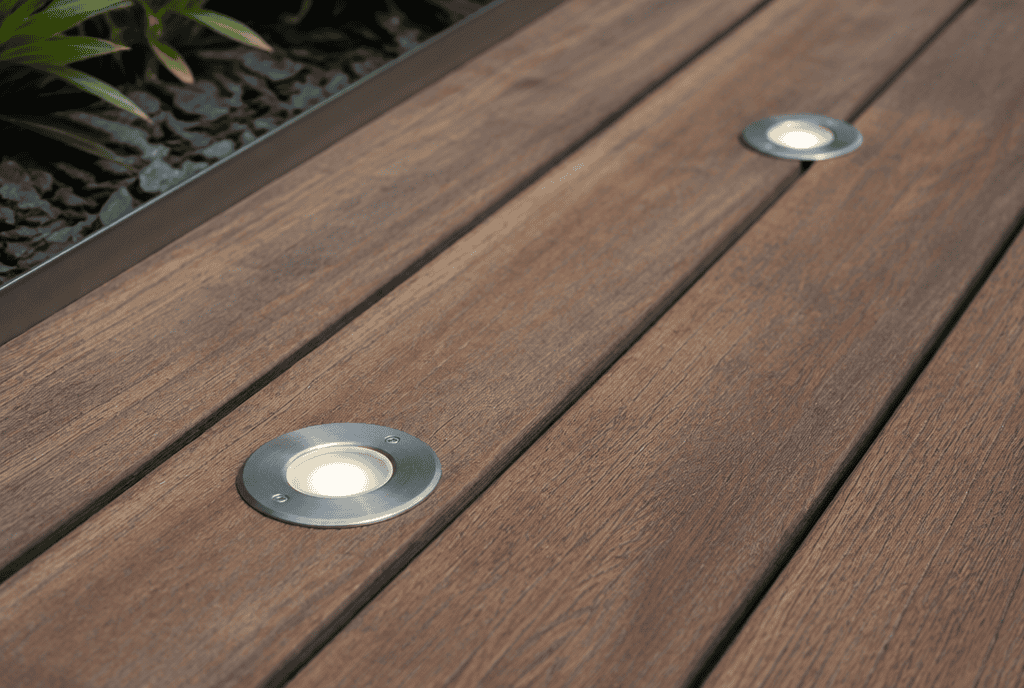
- Best for: A clean, contemporary look and lighting a deck surface or pathway without visible fixtures.
- Installation: The most involved of the three — requires drilling a hole sized to the fixture into the decking board itself, plus running and connecting low-voltage wire underneath.
- Cost: Materials run $10-$70 per fixture; fully installed, low-voltage deck lighting typically runs $200-$700 per fixture including labor.
For a smart-controlled version, the FVTLED LED Deck Lights Kit (30 lights, WiFi app control, low-voltage RGBW, waterproof, about $142) lets you dim and change color from your phone instead of a fixed warm-white glow.
Cost Comparison at a Glance
| Type | DIY Difficulty | Fixture Cost | Installed Cost (per fixture) |
|---|---|---|---|
| Post cap | Easy — no wiring (solar) or minimal wiring | $10-$40 | $50-$150 |
| Stair riser | Moderate — recess cut + low-voltage wiring | $10-$70 | $175-$600 |
| Recessed | Advanced — board drilling + wiring | $10-$70 | $200-$700 |
How to Install Low-Voltage Deck Lighting Yourself
- Choose a low-voltage transformer sized to your total light count (most residential kits cover 20-40 fixtures) and mount it near an existing GFCI-protected outdoor outlet.
- Plan your wire run along joists or the underside of the deck frame, keeping wire away from foot traffic and pinch points.
- For post caps: drill a small pass-through hole in the post top, feed the wire, and set the cap.
- For stair risers or recessed lights: cut the fixture recess with a hole saw sized to the light, run wire underneath, and connect using waterproof wire connectors.
- Connect all fixtures back to the transformer, test everything before closing anything up, and set the transformer’s timer or photocell for automatic dusk-to-dawn operation.
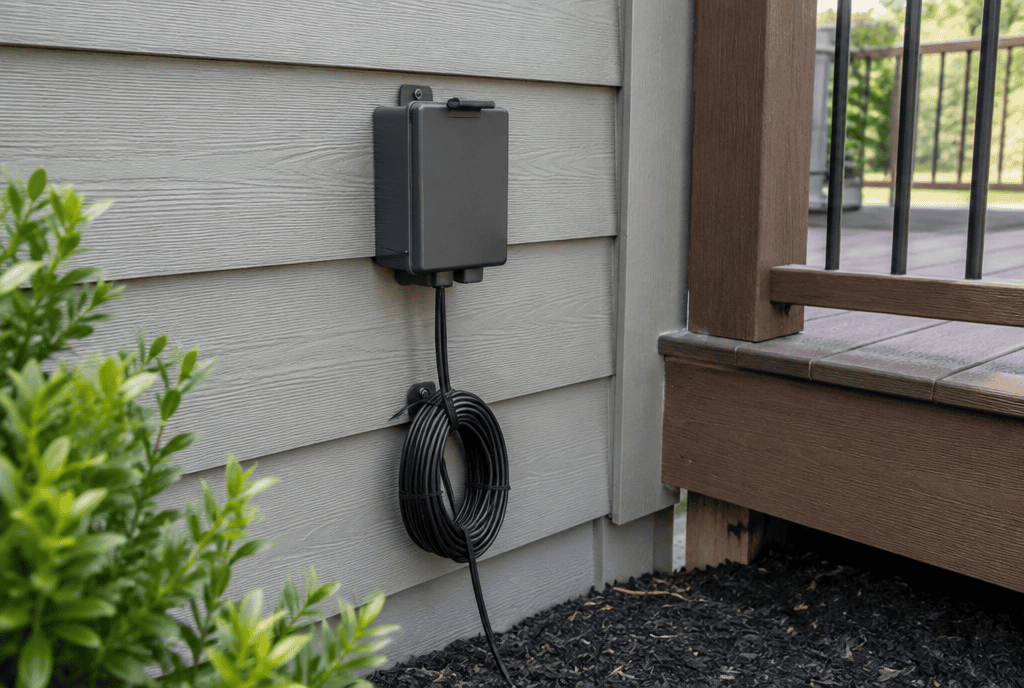
Low-voltage (12V) systems are safe to wire yourself without an electrician in most jurisdictions, since they’re not connected directly to line voltage — the transformer handles that conversion. If you’re not comfortable with any electrical work, this is still a same-day job for a licensed electrician.
Choosing the Right Combination for Your Deck
Most homeowners don’t need to pick just one type — the right combination depends on how your deck is actually used and what’s already limiting visibility at night.
- Small deck, tight budget: Start with solar post cap lights on the railing. No wiring, no transformer, and you can add more later.
- Deck with more than 3 stairs: Prioritize stair riser lights first, even before post caps — this is the safety-critical upgrade, not the decorative one.
- Multi-level or entertaining-focused deck: Layer all three. Post caps define the perimeter, stair lights handle transitions between levels, and recessed lights wash the walking surface for a finished, professional look.
- Rental or lease restrictions: Solar post caps and battery-powered stick-on stair lights avoid any wiring or permanent modification, which matters if your lease restricts drilling into the structure.
Common Mistakes to Avoid
- Skipping the GFCI requirement: Even low-voltage transformers plug into a standard outlet, and that outlet still needs to be GFCI-protected under NEC 210.8(F) since it’s outdoors.
- Overloading one transformer: Most residential transformers are rated for a specific total wattage — adding fixtures beyond that rating causes dimming or premature failure. Check the transformer’s max wattage against your total fixture count before buying more lights. A DEWENWILS 120W Low Voltage Landscape Transformer (120V to 12V, built-in timer and photocell, weatherproof, about $54) covers a typical mixed run of post cap, stair, and recessed lights with room to add more.
- Aiming stair lights outward instead of down: A stair riser light aimed at eye level is a glare hazard, not a safety feature — always choose shielded or louvered fixtures that direct light onto the tread below.
- Ignoring wire gauge on long runs: Low-voltage lighting loses brightness over long wire runs if the gauge is too thin. For runs over 50-75 feet from the transformer, step up to a heavier gauge wire to avoid dim fixtures at the far end.
- Forgetting a photocell or timer: Without one, you’re manually flipping a switch every evening. Most transformers include a photocell or timer option — it’s worth using from day one.
How Many Lights Do You Actually Need?
A reasonable starting point: one post cap light per railing post, one stair riser light per step (or every other step on a long staircase if budget is tight), and recessed lights spaced every 4-6 feet along a walking path or deck perimeter. For a typical 300-400 square foot deck with a 3-4 step staircase, that usually works out to 8-12 post caps, 3-4 stair lights, and 6-10 recessed fixtures if you’re doing the full layered approach — though most homeowners start with just one or two of these categories and add more later once the transformer and wiring are already in place.
Bottom line: Start with stair riser lights if safety is the priority, add post caps for the easiest visual upgrade, and reserve recessed lighting for when you want a fully finished, high-end look and don’t mind the extra installation work. Most decks look and function best with at least two of the three layered together.
Frequently Asked Questions
What’s the difference between post cap, stair riser, and recessed deck lights?
Post cap lights sit on top of railing posts for ambient perimeter lighting, stair riser lights mount into step risers to light the treads for safety, and recessed lights sit flush with the deck or stair surface for a clean, minimalist look.
How much does it cost to install deck lighting?
Fixtures alone run $10-$70 each. Professionally installed, expect $50-$150 per post cap light, $175-$600 per stair riser fixture, and $200-$700 per recessed light, including labor.
Can I install low-voltage deck lights myself?
Yes. Low-voltage (12V) systems run through a transformer plugged into a GFCI outlet, so the wiring itself is safe to DIY without an electrician in most areas — the main skill needed is careful wire routing and fixture placement.
Do deck stairs need lights for safety?
They’re not always required by code, but stair riser lights meaningfully reduce trip and fall risk on any deck with more than two or three steps, especially for guests unfamiliar with the layout.
What type of deck lighting is best for a small budget?
Solar post cap lights are the cheapest and easiest starting point — no wiring, no transformer, and fixtures start around $10-$15 each.
Can you combine different types of deck lighting?
Yes, and it’s usually the best approach — post caps for ambiance, stair risers for safety, and recessed lights for surface detail all run off the same low-voltage transformer system.
Explore More on Backyard Lighting
- Backyard Lighting: The Complete Guide for Every Space
- How Many Lumens Do You Need for Patio & Backyard Lighting?
- Solar vs. Wired Landscape Lighting: Which Is Better?
- Best Low-Voltage Landscape Lighting Kits for 2026
- Permanent Outdoor Lighting Systems: Are Smart RGBIC Lights Worth It?
Will Montgomery is an electro-mechanical engineer expanding his own outdoor space, including planning the deck and stair lighting he and his wife Kim use for backyard events.