


Quick answer: Choose wired low-voltage lighting when you want maximum brightness, all-night reliability, and a designed, zoned system — expect 100–200 lumens per fixture and some trenching. Choose solar when you want the easiest possible install with no wiring and no running cost — best in sunny spots, with most fixtures putting out 5–60 lumens and batteries that need replacing every 1–2 years. In short: wired for performance and control, solar for simplicity and zero setup.
Every landscape lighting project comes down to this fork in the road: run wires, or let the sun do the work. We’ve installed both around our own yard, and neither one is universally “better” — they solve different problems. Below is the honest side-by-side so you can match the technology to your yard, your budget, and how much digging you’re willing to do.
Landscape lighting is a low-voltage outdoor lighting system — powered either by a wired transformer or self-contained solar panels — used to illuminate paths, plantings, and architectural features after dark.
Last Updated: August 2026 | Will Montgomery has installed and compared both solar and wired low-voltage landscape lighting across real backyards, and knows where each one shines and where it falls short.
Solar vs. wired at a glance
| Factor | Solar | Wired Low-Voltage |
|---|---|---|
| Brightness per fixture | 5–60 lumens (typical) | 100–200 lumens |
| Reliability | Weather & sunlight dependent | Consistent every night |
| Installation | Push into ground — no wiring | Transformer + buried cable |
| Running cost | $0 | Low (a few dollars/month) |
| Upfront cost | Low | Moderate to high |
| Maintenance | Battery swaps every 1–2 yrs | Minimal; occasional bulb/connection |
| Control & zones | Per-light only | Full dimming, zoning, timers |
| Best for | Sunny paths, quick projects, renters | Architectural, security, whole-yard design |
Brightness: wired wins, but the gap is closing
This is the biggest real difference. High-end wired low-voltage path lights push 100–200 lumens per fixture with rock-steady output all night, which is why they dominate for uplighting trees, lighting facades, and security. Traditional solar lights have historically been dim — often just 5–15 lumens — which is fine for a soft path glow but not for lighting up a wall. That said, premium solar has improved fast, with better panels and batteries now delivering 40–60 lumens, enough for genuine pathway safety and ambient garden light. If raw brightness or security lighting is the goal, wired still wins. If you want a gentle nighttime glow, modern solar is more than adequate.
Reliability and sunlight
Wired lighting draws from your home’s power through a low-voltage transformer, so it turns on at dusk and stays at full brightness until it shuts off — rain, shine, or midwinter. Solar depends on how much direct sun the panel caught that day. In a sunny, open yard, quality solar performs well. Under trees, on a north-facing wall, or through a stretch of cloudy weather, solar dims early or doesn’t fully charge. Be realistic about how much direct sunlight each fixture’s location actually gets before you commit to solar there.
Installation and cost
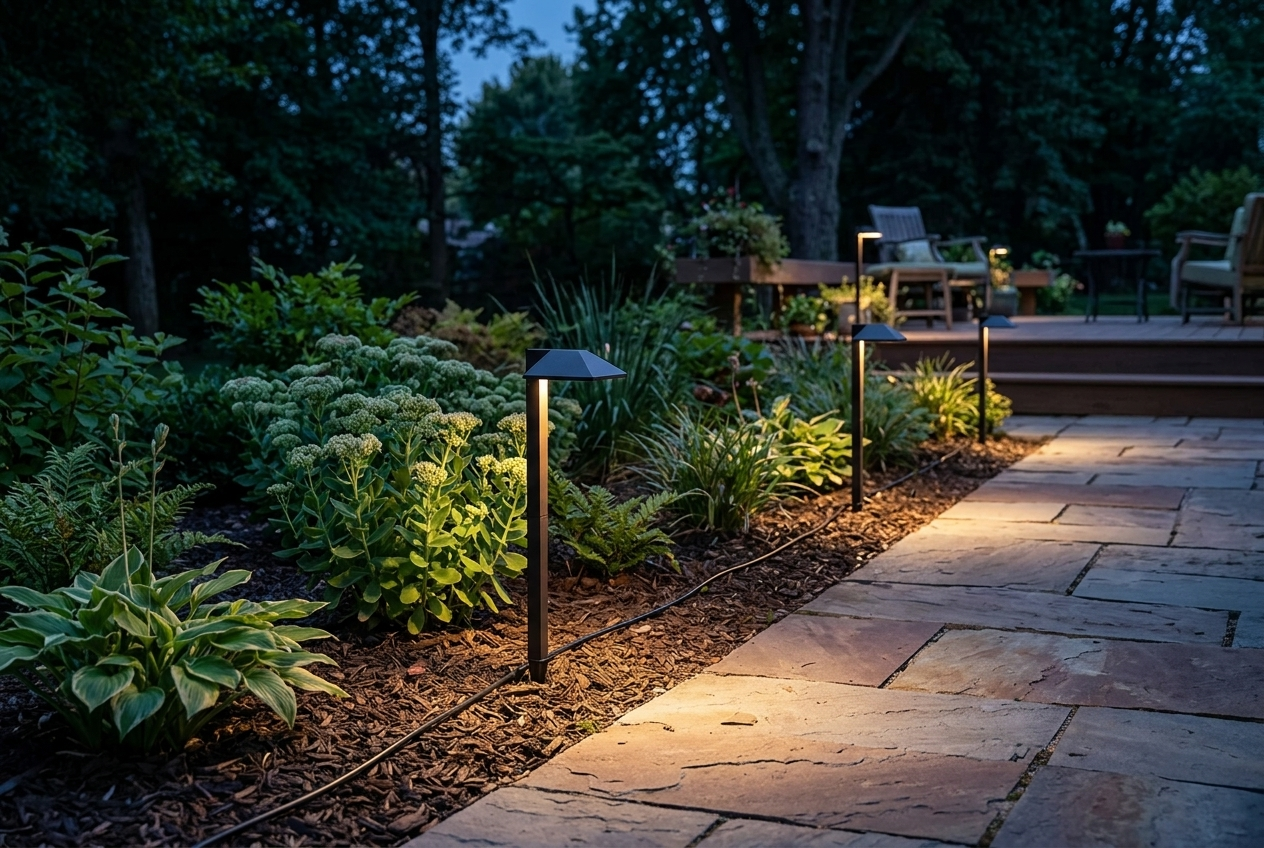
Solar is the clear winner on ease: unbox, push the stakes into the ground, done. There’s nothing to wire, no transformer, no trenching, and no electrician — which also makes it the go-to for renters who can’t modify a property. Wired low-voltage takes planning: you mount a transformer near an outdoor outlet, run buried cable to each fixture, and connect them up. It’s very much a DIY-able weekend project, but it is a project.
On money, solar has a lower upfront cost and zero running cost, but the batteries degrade and typically need replacing every one to two years, so the lifetime cost creeps up. Wired costs more upfront (fixtures, transformer, cable) and adds a small amount to your power bill, but quality wired fixtures last for years with little maintenance. If you’re pricing out a wired system, our roundup of the best low-voltage landscape lighting kits is a good starting point; for the solar route, see our best solar lights for the backyard picks.
Control, zoning, and design
If you want a designed lighting scheme — warm uplights on the trees, brighter task light by the steps, everything on a timer or app — wired is the only real option. A transformer lets you zone circuits, add smart timers, and dim. Solar lights are islands: each one does its own thing, charges on its own, and you can’t group or dim them centrally. For layering an entertaining space, that centralized control matters, which is something we get into in the complete backyard lighting guide. App-controlled RGBIC permanent lighting takes wired control even further, with full color scenes instead of just on/off zoning — see our guide to whether permanent RGBIC lights are worth it.
Safety
Both are safe when installed correctly. Low-voltage wired systems run at 12 volts through the transformer, which is far safer than line voltage, but the connections should still be done properly and kept weatherproof. Solar carries no shock risk at all since there’s no household wiring. If shock safety around water features or wet areas is a concern, we cover it in is landscape lighting safe from shock.
So which should you buy?
From experience: With today’s lithium-ion batteries and better panels, solar is so much easier to live with. But here’s the catch — if you want the lights on all night as a security deterrent or to accent the house, go wired. If you just want them on from dusk until the house turns in around 11 or 1 AM, solar is plenty.
- Choose solar if: you rent or don’t want to wire anything, your fixtures get good direct sun, you want a soft path/garden glow, and you like $0 running cost.
- Choose wired if: you want bright, dependable, all-night light, you’re uplighting trees or a facade, you want security lighting, or you want a zoned, dimmable, designed system.
- Do both: plenty of yards run wired for the architectural and security lighting and drop in solar path lights along a sunny walkway. It’s a perfectly good hybrid.
Bottom line: Wired low-voltage is the performance-and-control choice; solar is the simplicity-and-zero-cost choice. Match the tech to the job — and don’t be afraid to mix them in one yard.
Frequently asked questions
Is solar or wired landscape lighting brighter?
Wired is brighter. Quality wired fixtures produce 100–200 lumens each versus roughly 5–60 lumens for solar. For uplighting and security, wired is the clear pick; for soft path lighting, premium solar is bright enough.
Do solar lights work in winter or shade?
They work, but weakly. Short winter days and shady spots mean less charge, so lights dim earlier or don’t run all night. In low-sun locations, wired is far more reliable.
Is wired low-voltage lighting hard to install?
It’s a manageable DIY weekend project: mount a transformer at an outdoor outlet, run buried low-voltage cable, and connect the fixtures. No electrician is usually required since it’s 12-volt, but plan the layout first.
How long do solar light batteries last?
Most need replacement every one to two years. Higher-end fixtures with replaceable batteries and glass-covered panels can last five years or more before performance drops noticeably.
Which is cheaper overall?
Solar is cheaper upfront and has no running cost, but battery replacements add up. Wired costs more to buy and install and adds a little to your power bill, but lasts longer with less part-swapping. Over five years they can land closer than you’d think.
Can I combine solar and wired lighting?
Absolutely. A common setup is wired uplighting and security lights plus solar path lights on a sunny walkway. Mixing lets you put reliable light where it matters and free, easy light where sun is plentiful.
For the full plan — layering, fixture types, and layout — start with our complete backyard lighting guide.