

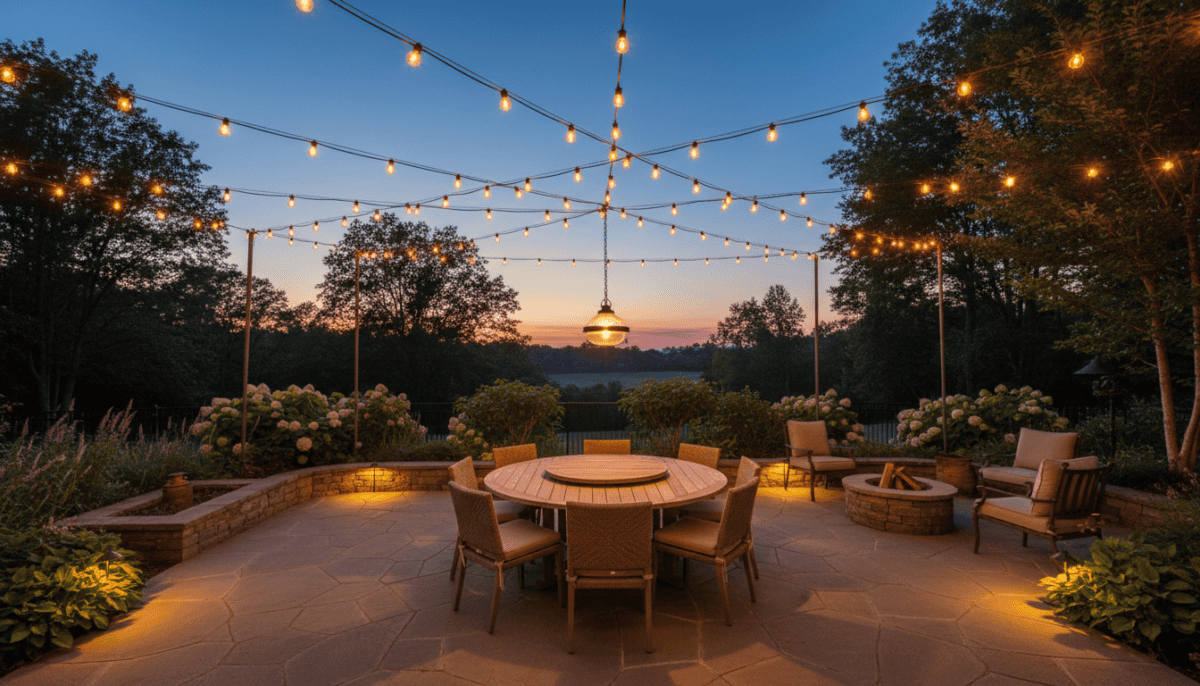
A patio with one bright overhead light isn’t set up for entertaining — it’s set up for changing a tire. Guests linger longer, look better, and relax faster under lighting that’s layered instead of just switched on.
Quick Answer: Layer three types of light: ambient (a wall light or string lights for overall glow), task (a pendant or spotlight over the dining/cooking area), and accent (path lights or lanterns that define edges and add depth). Stick to warm white bulbs (2700K-3000K) throughout, and put ambient and task lighting on separate switches or smart plugs so you can dial the mood up or down through the night.
Last Updated: August 2026 | Will Montgomery has spent years designing and wiring backyard lighting for Outdoor Space Accents, from low-voltage path runs to string-light spans over open patios.
Why Layering Beats One Big Light
A single overhead floodlight lights everything evenly and flatters nothing — it flattens shadows, washes out faces, and makes a patio feel more like a parking lot than a place to sit down. Layering mixes light at different heights and brightness levels so the space has depth: brighter where people are doing something (cooking, eating, pouring drinks), dimmer where they’re just relaxing, and a few defining accents around the edges so the whole patio doesn’t fade into black past the table.
The Three Lighting Layers
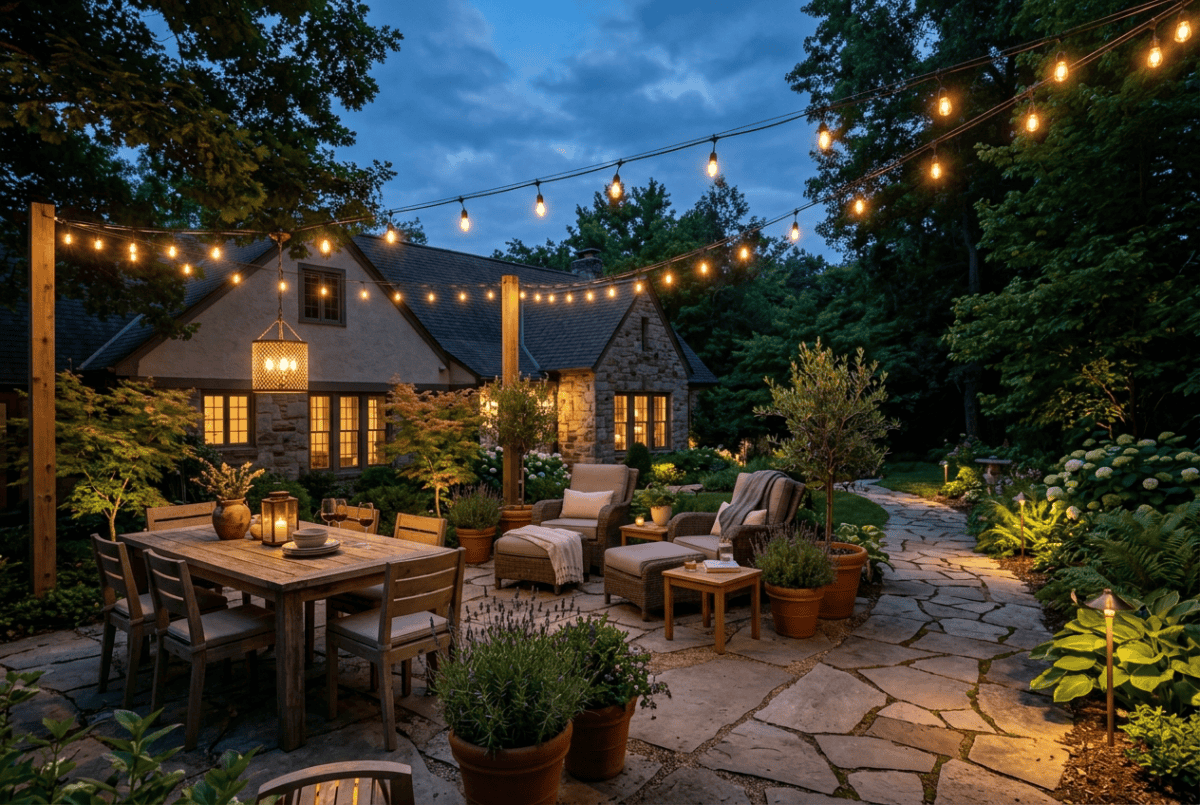
From experience: I go solar wherever I can on a patio — the exception is safety lighting, like an actual porch light or access lighting, which I keep hardwired.
For the overhead layer, commercial-grade sets like the Brightech Ambience Pro LED string lights hold up to weather far better than seasonal box-store strands.
1. Ambient Lighting (the base layer)
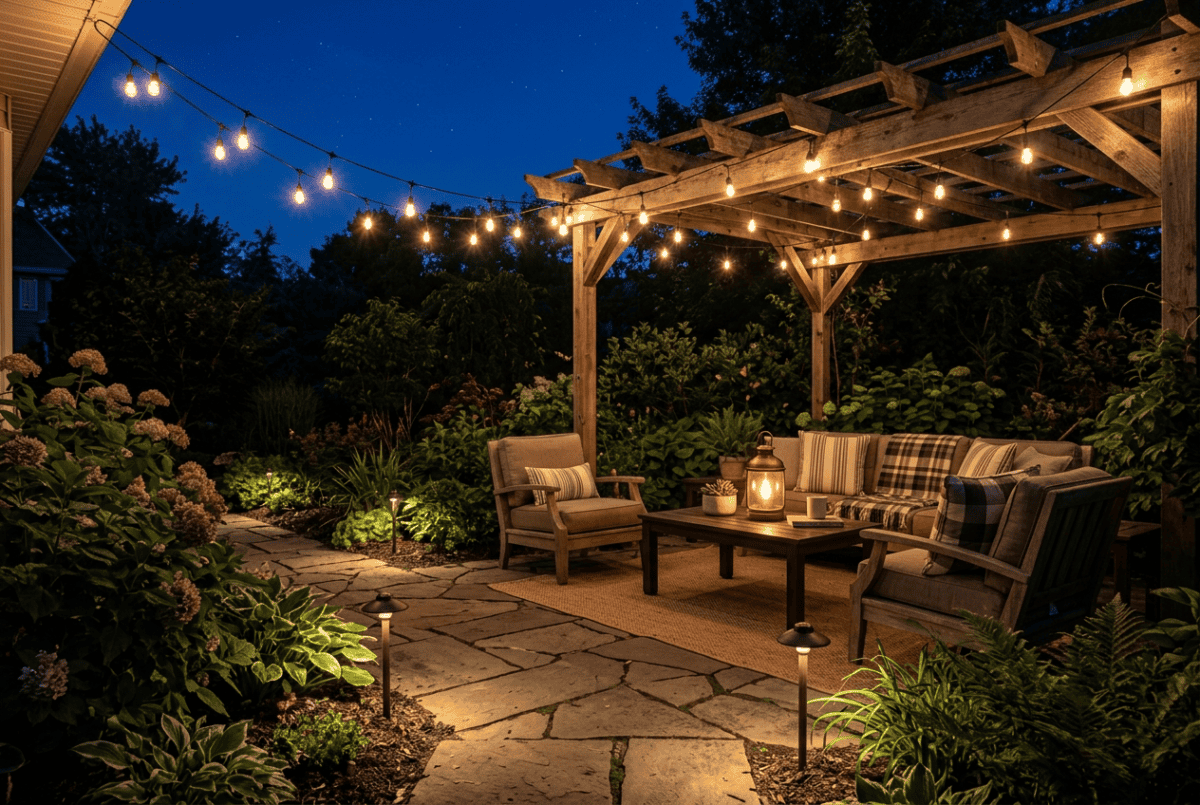
This is the light that makes the space feel inhabited before anything else turns on — a pair of wall sconces, a linear LED bar along the house wall, or a run of string lights overhead. Aim for soft, even coverage rather than brightness; this layer should let people see each other’s faces comfortably without feeling like daylight.
2. Task Lighting (the functional layer)
Task lighting goes exactly where an activity happens: a pendant over the dining table, a spotlight on the grill, a sconce by the drink station. If your patio is covered, a single pendant centered over the table does more to define “this is where we eat” than any other fixture — it’s often called the single most effective gesture in outdoor entertaining lighting.
3. Accent Lighting (the depth layer)
Low-level accent lights define edges, steps, and planting beds — path lights, uplights on a tree or planter, or lanterns set on a side table. This layer matters more for safety than most people realize: it marks the spot where a step or curb could trip a guest who doesn’t know the patio the way you do.
Layering Plan by Patio Size
| Patio Size | Ambient | Task | Accent |
|---|---|---|---|
| Small (under 150 sq ft) | 1 string light run or 2 wall sconces | 1 pendant or clip light over the table | 2-4 solar path lights or lanterns |
| Medium (150-350 sq ft) | String lights + 1-2 wall fixtures | Pendant over dining + task light near grill | 4-8 path lights, 1-2 planter uplights |
| Large (350+ sq ft) | Low-voltage landscape run + string lights | Dining pendant + grill task light + lounge lamp | 8+ path lights, multiple uplights, string accents |
Step-by-Step: Building Your Layers
- Start with ambient. Hang string lights or install wall sconces first — this is your baseline light level for the whole evening.
- Add task lighting where people work. Hang or mount a fixture over the dining table and near the cooking area.
- Layer in accent lighting last. Line the path, deck edge, or planting beds with low-voltage or solar fixtures.
- Match color temperature across all three layers. Mixing warm (2700K) and cool (5000K) bulbs on the same patio reads as mismatched and unfinished — pick 2700K-3000K warm white for everything.
- Put ambient and task lighting on separate controls. A smart plug or simple switch lets you dim ambient light down for a movie night while keeping task lighting available near the grill.
- Test it after dark before your first event. Walk the patio at night and check for glare, dark spots near steps, or any bulb shining directly into seating.
Bottom line: Don’t buy one big light — build three small layers. Ambient for overall glow, task lighting over the table and grill, and accent lighting along paths and edges. Keep every bulb warm white and put ambient/task on separate switches so the mood can shift through the night. For total brightness targets by fixture, see our patio lighting lumens guide.
For the ground layer, a set like this 12-pack of warm-white waterproof solar path lights handles walkways with zero wiring.
Frequently Asked Questions
What’s the easiest way to start layering patio lighting on a budget?
Start with a run of warm-white string lights for ambient light, then add a few solar path lights for accent — both are inexpensive, need no wiring, and cover two of the three layers for under $100 in most cases.
Should I use solar or wired lights for patio entertaining?
Solar works well for accent lighting like path lights, where consistent, bright output matters less. For ambient and task lighting — where you want reliable brightness every time you flip a switch — wired or plug-in fixtures are the more dependable choice. Our solar vs. wired comparison breaks down the tradeoffs in detail.
What color temperature should outdoor entertaining lights be?
Stick with warm white, 2700K to 3000K, across every fixture. It’s the most flattering and relaxing temperature for entertaining and matches the warm glow of candles and firelight, which most people already associate with a good patio evening.
How many light sources does a small patio actually need?
A small patio under 150 sq ft can get all three layers from as few as 3-4 fixtures: one ambient source (string lights or sconces), one task light over the table, and 2-3 accent path lights or lanterns.
Can I control layered lighting from my phone?
Yes — smart plugs and smart bulbs rated for outdoor use let you group each lighting layer into its own app scene, so you can dim ambient light for a movie night while leaving task and accent lighting on full for safety.
What’s the biggest mistake people make with patio lighting?
Relying on a single bright fixture instead of layering. One overhead floodlight lights the whole space evenly but flatters nothing and leaves no way to dim the mood — spreading the same total brightness across three layers looks better and gives you far more control.
Ready to build out your fixtures? Start with our complete backyard lighting guide, then browse low-voltage landscape lighting kits for wired accent options.
Will is an electro-mechanical engineer and hands-on homeowner who has wired and layered lighting across his own patio while expanding the space with his wife Kim, who hosts backyard events.